"Is our AI strategy actually working?"
It's a question many business leaders grapple with, often feeling the pressure to show a clear return on investment. You've poured resources into AI initiatives, perhaps invested in new tools, or even redesigned workflows. But when it comes time to measure success, the conversation often grinds to a halt at one metric: financial ROI.
While financial returns are undoubtedly important, focusing solely on them for AI success is like judging a gourmet meal only by its cost. You miss the flavor, the experience, and the skill that went into it. The true value of AI in your organization extends far beyond immediate cost savings or revenue bumps. It touches everything from employee morale to your company's ability to innovate and even its ethical standing.
If you’ve ever felt that a narrow focus on dollars and cents doesn't quite capture the full impact of your AI efforts, you're not alone. Many organizations are discovering that to truly understand if their AI strategy is successful, they need to look at a broader spectrum of indicators—what we call non-financial Key Performance Indicators (KPIs).
These non-financial KPIs provide a holistic view, revealing how AI is strengthening your organizational core, empowering your team, and positioning you for future growth in ways financial statements simply can’t reflect. They are the leading indicators of long-term sustainable advantage.
The Blind Spot: Why Financial ROI Alone Isn't Enough for AI
Think about it: many revolutionary technologies didn't show immediate, massive financial returns. The internet, for instance, took years to prove its profit-generating power, but its early success was measured in adoption rates, information accessibility, and communication efficiency. AI is no different.
AI projects often involve:
- Longer Incubation Periods: AI development can be iterative, with value accruing over time as models improve and adoption grows.
- Indirect Benefits: AI's impact might manifest as improved decision-making, faster innovation cycles, or enhanced customer satisfaction—all of which eventually contribute to financials, but not always directly or immediately.
- Intangible Assets: AI builds data assets, intellectual property, and institutional knowledge that are hard to price on a balance sheet but are critical for competitive advantage.
Relying solely on financial KPIs can lead to premature abandonment of promising AI initiatives or a skewed perception of success and failure. It creates a critical blind spot that prevents you from seeing the bigger picture.
For instance, an AI-powered customer service chatbot might not immediately reduce headcount (a financial saving), but its ability to resolve queries faster could dramatically increase customer satisfaction, leading to better retention and word-of-mouth referrals—intangible gains that eventually fuel growth.
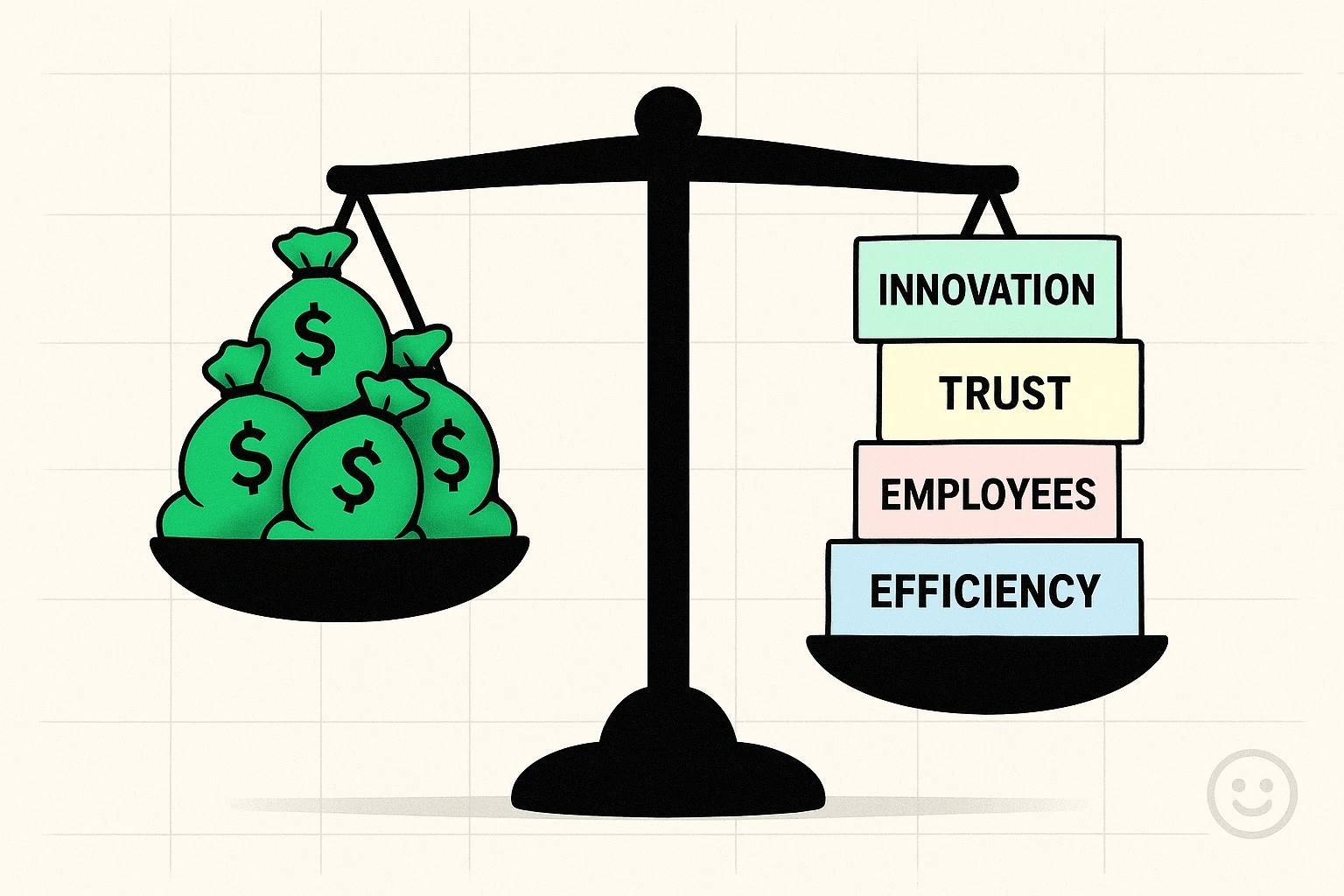
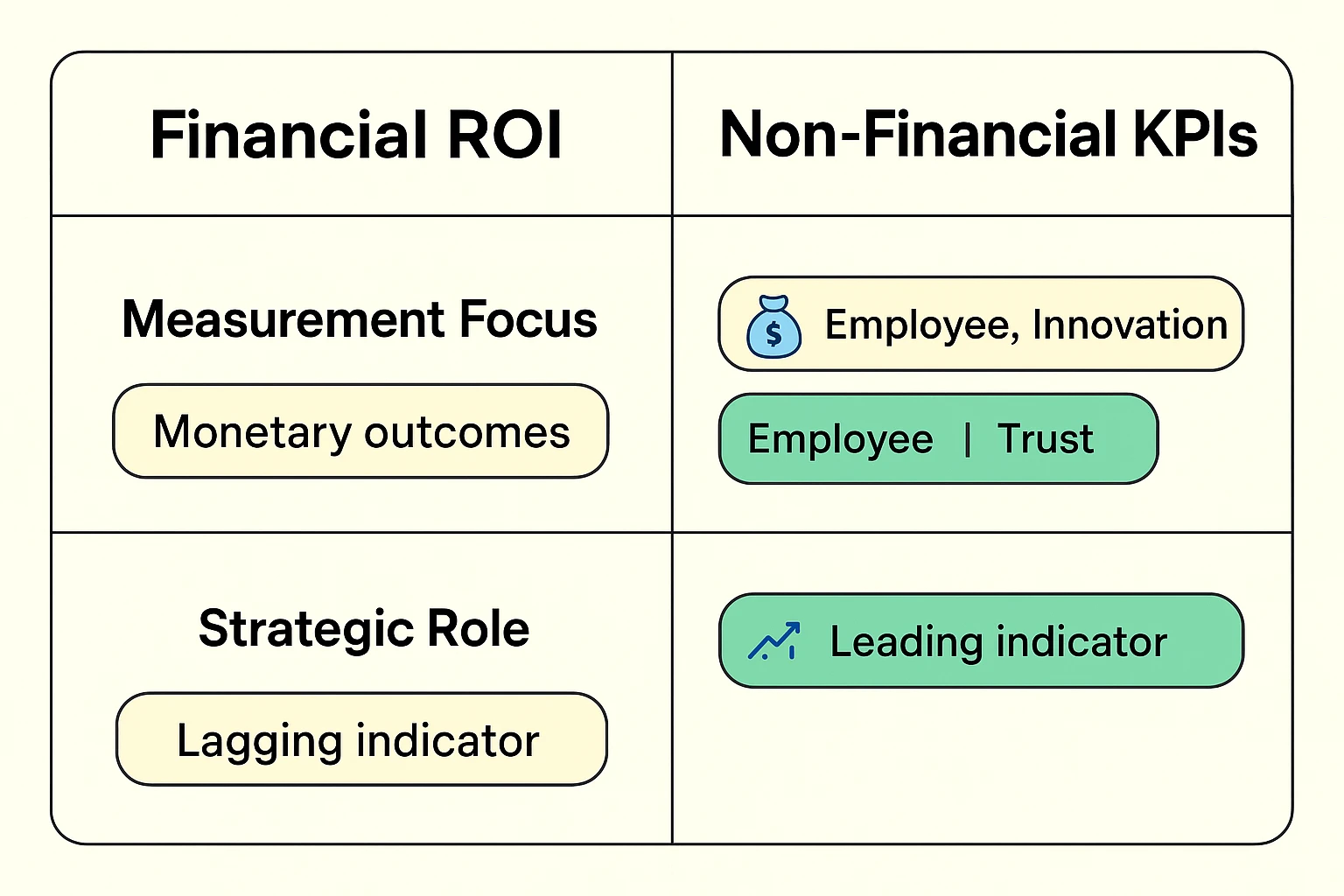
Here's a quick look at how financial and non-financial metrics complement each other:
This is where non-financial KPIs step in. They measure the true strategic dimensions of AI success, focusing on areas like:
- Employee Experience & Empowerment: How AI impacts your workforce.
- Innovation & Capability Building: How AI fuels new ideas and internal expertise.
- Risk Reduction & Trust: How AI enhances security, compliance, and stakeholder confidence.
- Operational Efficiency (Beyond Cost): How AI streamlines processes and improves quality.
These categories aren't "soft" metrics; they are indicators of resilience, adaptability, and long-term value creation.
The 'Beyond ROI' Model: Four Pillars of AI Success
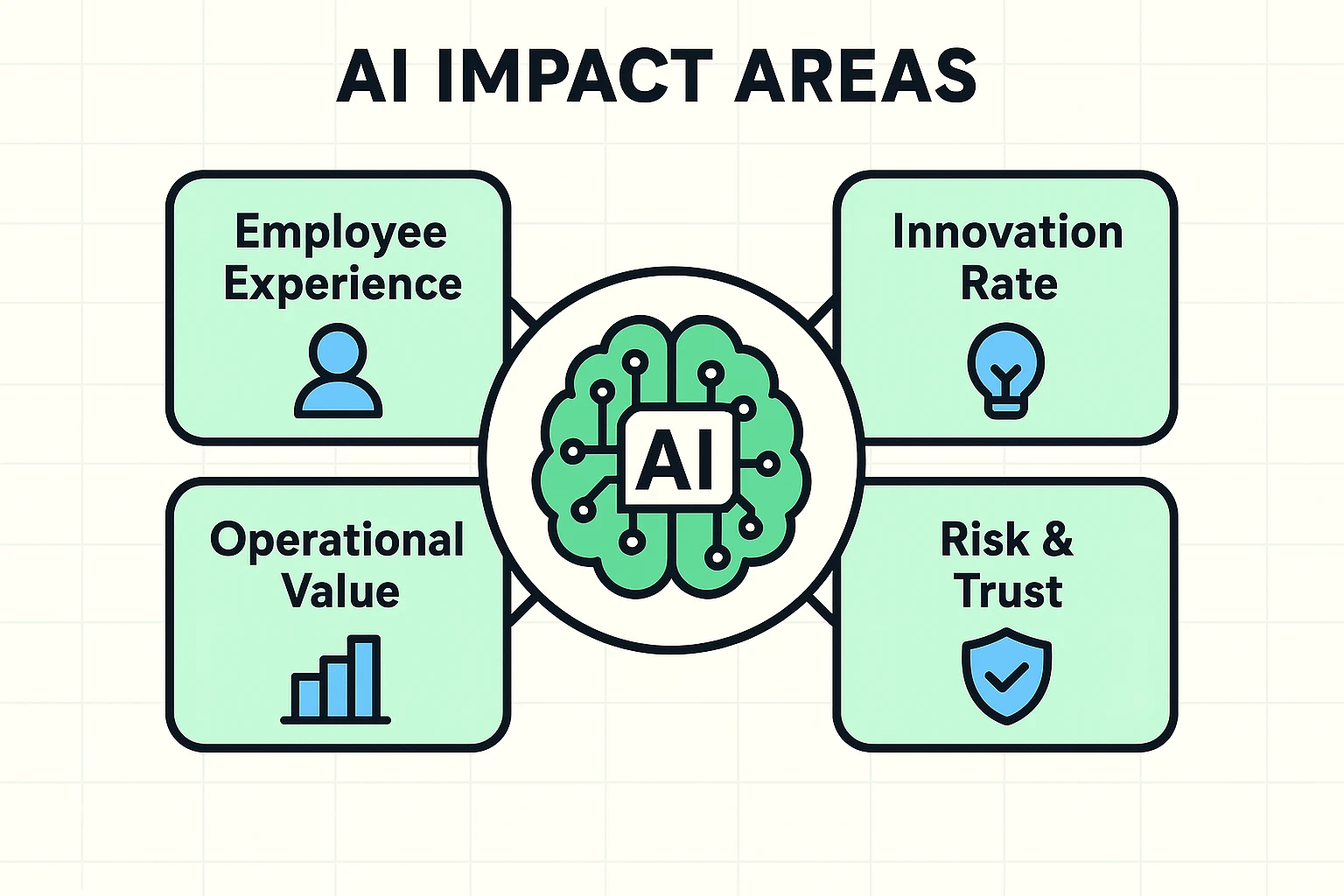
To gain a truly comprehensive understanding of your AI strategy's impact, consider this "Beyond ROI" model, which categorizes non-financial KPIs into four critical dimensions:
Let's dive into each pillar:
1. Employee Experience & Empowerment
AI isn't just about replacing tasks; it's about augmenting human potential. A successful AI strategy should make employees more effective, engaged, and even happier. This directly contributes to retention, productivity, and overall organizational health.
Why it matters: AI can lead to fear of job displacement, but when implemented thoughtfully, it frees up employees from tedious, repetitive tasks, allowing them to focus on more strategic and creative work. This can boost job satisfaction and skill development.
Key Non-Financial KPIs:
- Employee Satisfaction with AI Tools: Measured through internal surveys specifically asking about user experience, perceived usefulness, and ease of use of AI applications. (e.g., "On a scale of 1-5, how much does AI assist you in your daily tasks?")
- AI Tool Adoption Rate: Percentage of target employees actively using new AI systems or features. Low adoption often indicates poor design, lack of training, or insufficient perceived value.
- Time Saved on Repetitive Tasks: Tracked through self-reporting or system analytics comparing time spent on certain tasks before and after AI implementation.
- Upskilling & Reskilling Engagement: Number of employees participating in AI-related training programs or internal learning paths. This indicates future readiness and internal capability growth.
- Internal AI Ideation & Contribution: Number of employee-generated ideas for new AI applications or improvements to existing ones, reflecting active engagement and innovation from within.
2. Innovation & Capability Building
AI is a catalyst for innovation. A truly successful AI strategy cultivates an environment where new ideas flourish, and the organization's capacity to develop and leverage advanced technologies grows. This is especially crucial for staying competitive in rapidly evolving markets.
Why it matters: Investing in AI should make your company smarter and more agile. It should enable you to develop new products, services, or internal processes that weren't possible before. These are the future growth engines.
Key Non-Financial KPIs:
- Number of AI-Powered Innovations: Count of new products, services, or significant process improvements directly enabled or accelerated by AI technologies.
- Time-to-Market for AI-Enabled Products: Reduction in the time it takes to launch new offerings that incorporate AI elements, reflecting enhanced agility.
- AI-Driven Patent Applications/IP: Number of intellectual property filings related to AI algorithms, applications, or data insights.
- Internal AI Skill Maturity Score: An assessment of your workforce's collective AI literacy and technical skills, indicating growth in internal capabilities crucial for future AI development.
- Cross-Departmental AI Collaboration: Number of successful AI projects involving multiple teams, demonstrating deeper integration and a culture of AI-driven problem-solving.
3. Risk Reduction & Trust
AI brings both immense opportunities and unique risks. A successful AI strategy isn't just about what AI can do, but what it can do safely, ethically, and in compliance with regulations. Building trust—both internally and externally—is paramount. This pillar emphasizes responsible AI development and deployment.
Why it matters: AI models can carry biases, misinterpret data, or operate beyond established ethical boundaries. Proactively addressing these risks protects your brand reputation, avoids costly legal issues, and fosters user confidence. This is where AI governance becomes a central concern.
Key Non-Financial KPIs:
- AI Model Fairness/Bias Score: Quantifiable metrics measuring the equitable performance of AI models across different demographic groups or data subsets. Regularly audited against predefined benchmarks.
- AI System Explainability/Transparency Score: An assessment of how well the decision-making process of an AI model can be understood and explained to human users.
- Data Security & Privacy Compliance Rate: Percentage of AI systems that adhere to relevant data protection regulations (e.g., GDPR, CCPA) and internal privacy policies. Track audits and non-compliance incidents.
- AI-Related Error/Incident Reduction: Decrease in the number of critical errors, false positives/negatives, or system failures directly attributable to AI deployment.
- Customer/Stakeholder Trust Surveys: Polling external parties (customers, partners) on their confidence in your organization's use of AI, particularly concerning data handling and ethical practices.
4. Operational Efficiency (Beyond Cost)
While some operational efficiency leads to cost savings (a financial KPI), many aspects improve processes, quality, and scalability without directly impacting the bottom line in the short term. These benefits allow your business to do more with the same or fewer resources, creating capacity.
Why it matters: AI can automate mundane tasks, optimize resource allocation, and accelerate workflows. Measuring these improvements in terms of speed, accuracy, and throughput provides crucial insights into how AI is enabling your organization to operate more effectively. This creates bandwidth, allowing your team to focus on higher-value activities. Whether in AI recruiting solutions or for enterprise solutions, this capacity liberation is key.
Key Non-Financial KPIs:
- Process Cycle Time Reduction: Decrease in the time it takes to complete a specific business process after AI integration (e.g., invoice processing, lead qualification, content generation via AI SEO automation).
- Data Accuracy/Quality Improvement: Percentage reduction in data entry errors or increase in the reliability of analyzed data thanks to AI.
- Resource Utilization Optimization: Metrics showing improved allocation of human or technical resources through AI-driven scheduling, predictive maintenance, or workload balancing.
- Throughput Increase: Rise in the volume of work processed (e.g., customer queries handled, marketing campaigns launched) without a proportional increase in human effort.
- System Uptime & Reliability of AI Applications: Percentage of time AI systems are fully operational and performing as expected, indicating robustness.
The Journey from Pilot to Scale: Evolving Your KPIs
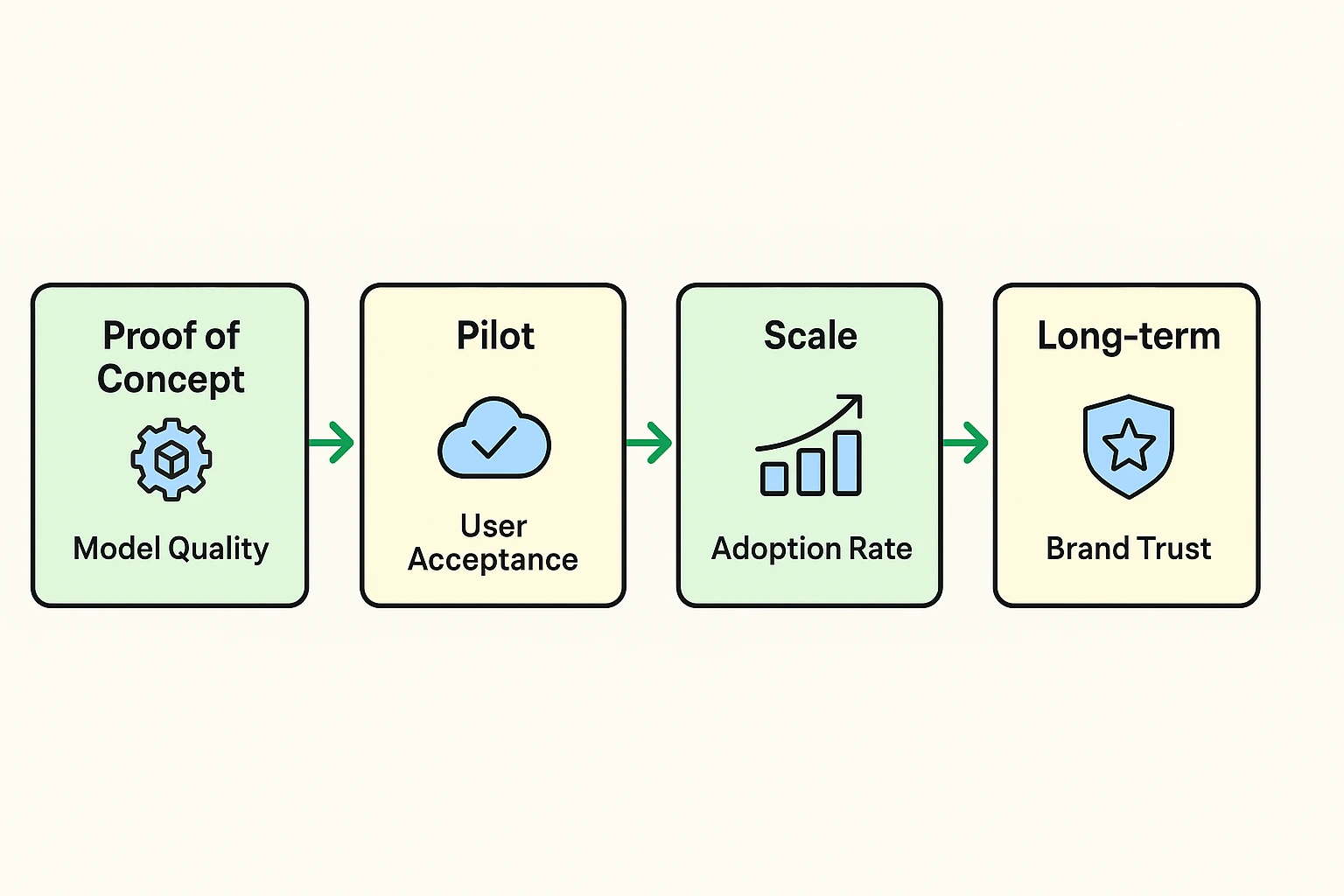
The KPIs you prioritize will—and should—change as your AI initiatives mature. What matters in a proof-of-concept phase won't be the same as measuring the success of a fully integrated, enterprise-wide AI system.
- Pilot/Proof-of-Concept: Focus on technical performance (model accuracy, speed), initial user acceptance, and feasibility. You're proving the concept can work.
- Initial Deployment: Shift focus to adoption rates, immediate operational impact (e.g., process cycle time changes), and early signs of employee engagement.
- Scaling & Integration: Emphasize expanded adoption, data quality, security, and the consistency of benefits across broader use cases. Are things working smoothly as you roll out globally?
- Mature AI Operations: At this stage, your KPIs should reflect broader strategic impact: innovation rates, building trust, and long-term talent development. You're leveraging AI for sustained competitive advantage.
By periodically reassessing and adapting your KPI framework, you ensure that your measurement strategy remains aligned with the evolving goals and maturity of your AI initiatives.
Integrating Non-Financial KPIs: A Practical Approach
So, how do you start integrating these non-financial KPIs into your AI strategy? Here's a quick roadmap:
- Define AI Goals Beyond Money: Before picking KPIs, clarify what you want your AI initiatives to achieve in terms of employee experience, innovation, risk, and operations.
- Identify Relevant Stakeholders: Who cares about these different dimensions of success? HR cares about employee satisfaction; the legal team cares about compliance. Involve them.
- Establish Baselines: Even for "soft" metrics, you need a starting point. Conduct surveys, analyze historical data, or establish benchmarks before AI implementation.
- Choose Measurable Indicators: Select KPIs that are as quantifiable as possible. For qualitative aspects (like sentiment), use structured surveys, sentiment analysis tools, or clear scoring rubrics.
- Integrate into Dashboards: Combine financial and non-financial KPIs into unified dashboards that provide a holistic, real-time view of your AI strategy's performance.
- Communicate Broadly: Share progress on non-financial KPIs with all stakeholders. This helps build buy-in, demonstrates value beyond traditional metrics, and fosters an AI-first culture.
The Future of AI Measurement is Holistic
Measuring the success of your AI strategy is more complex than just glancing at a spreadsheet. It requires a thoughtful, multi-dimensional approach that accounts for the profound impact AI has on your people, your processes, your capacity for innovation, and your organizational integrity.
By embracing non-financial KPIs, you move beyond mere measurement. You gain a deeper understanding of AI’s true value, empowering you to make smarter decisions, foster a thriving AI-ready culture, and ultimately, build an AI-first business that is resilient, innovative, and deeply trusted. This isn't just about proving value; it's about guiding your organization towards a more intelligent and sustainable future.
Frequently Asked Questions (FAQs) About AI KPIs
Q1: What is the primary difference between financial and non-financial KPIs for AI?
A: Financial KPIs for AI directly measure monetary impact, such as cost savings, revenue increase, or return on investment (ROI). Non-financial KPIs, on the other hand, measure the broader, often intangible benefits of AI, such as improvements in operational efficiency (beyond cost), employee satisfaction, innovation rates, risk reduction, and brand trust. While non-financial KPIs eventually contribute to financial success, they do so indirectly and over a longer term, acting as leading indicators.
Q2: Why are non-financial KPIs becoming so important for AI success measurement?
A: Non-financial KPIs are crucial because AI's value often isn't immediately apparent in monetary terms. AI initiatives can have long development cycles, and their benefits might first appear as improved processes, empowered employees, or enhanced innovation—all of which build long-term strategic advantage. Relying solely on financial KPIs can lead to underestimating AI's impact, premature project cancellations, or a failure to see the full picture of an AI investment.
Q3: How can I measure seemingly "soft" non-financial KPIs like employee satisfaction or trust?
A: Even "soft" metrics can be quantified with thoughtful approaches. For employee satisfaction, use structured surveys, pulse checks, or even sentiment analysis of internal communications. For innovation, track the number of AI-enabled patents, successful pilot projects, or ideas submitted through an internal AI ideation program. For trust, conduct specific surveys with customers or partners regarding their confidence in your AI use, or track the reduction in AI-related incidents or complaints. The key is to standardize your measurement method and establish baselines.
Q4: Should I completely replace financial KPIs with non-financial ones?
A: Absolutely not! The most effective approach is a holistic one that integrates both financial and non-financial KPIs. Think of them as complementary. Financial KPIs tell you if your AI is generating monetary returns, while non-financial KPIs tell you how it's creating foundational value, driving strategic growth, and building internal capabilities that will sustain those long-term financial returns. They provide a 360-degree view of success.
Q5: How do non-financial KPIs tie into overall business strategy?
A: Non-financial KPIs should be directly linked to your broader organizational goals. For example, if your business strategy is to be a market leader in innovation, then KPIs like "number of AI-driven patents" or "time-to-market for AI-enabled products" directly support that. If a key business objective is to attract and retain top talent, then "employee satisfaction with AI tools" and "upskilling engagement" are highly relevant. This ensures your AI efforts are not operating in a silo but are actively contributing to strategic achievements.
Join Our Growing AI Business Community
Get access to our AI Automations templates, 1:1 Tech support, 1:1 Solution Engineers, Step-by-step breakdowns and a community of forward-thinking business owners.

Latest Blogs
Explore our latest blog posts and insights.