The sheer volume of AI solutions promising to revolutionize your business is overwhelming. You’re past the hype, actively evaluating how artificial intelligence can genuinely transform your value proposition, not just automate rudimentary tasks. The question isn't if AI will impact your business, but how you can embed it at your core to unlock unprecedented growth and differentiation. This isn't about incremental gains; it's about fundamentally rethinking your business model.
At BenAI, we understand this evaluation challenge. Our expertise lies in guiding leaders like you through this critical decision-making process, providing the strategic frameworks and practical implementations needed to transform your organization into an AI-first entity.
The AI Imperative: From Efficiency to New Value
For years, AI's promise centered on efficiency—automating repetitive tasks, streamlining operations, and cutting costs. While these benefits remain crucial, the paradigm has shifted. Today, AI, particularly generative AI, is a catalyst for creating entirely new value propositions and business models. McKinsey reports that 78% of organizations used AI in some capacity in 2024, an increase from 55% in 2023. Yet, most are still in the pilot or experimental phases, struggling to move beyond basic automation to strategic differentiation. This indicates a significant opportunity for businesses that can effectively embed AI at their core.
The global AI market is projected to reach approximately $827 billion by 2030, growing at a CAGR of 28.5% from $184 billion in 2024. Generative AI alone is expected to expand from $36 billion in 2024 to $356 billion by 2030, a staggering 46% annual growth. This isn't just market expansion; it's a profound redefinition of business capabilities.
Beyond Automation: Redefining Value Creation with AI
Truly AI-powered business models aren't just about doing the same things faster; they're about doing entirely new things.
- AI-Driven Product Innovation: AI can imbue products with adaptive intelligence, predictive capabilities, and hyper-personalization. Imagine a B2B SaaS platform that not only automates reporting but proactively predicts client churn based on usage patterns and suggests tailored interventions. Or a manufacturing solution that uses AI for predictive maintenance, anticipating equipment failures before they occur, drastically reducing downtime. These aren't just features; they're completely new service tiers. Our work with AI Marketing Solutions focuses on adopting proven AI marketing systems that drive growth by automating service delivery, allowing agencies to scale 10x faster.
- Reimagining Customer Journeys: AI enables hyper-personalized, proactive support and seamless omnichannel experiences. Zendesk reports that 90% of CX trendsetters believe AI will resolve 80% of issues without human intervention within a few years. Through generative AI in customer service and sophisticated AI agents, businesses can offer instant, context-aware support. Gorgias, for instance, highlights that AI agents can resolve 60% of support inquiries and increase conversions 2.5x through tailored recommendations for e-commerce. This transforms customer service from a cost center into a powerful differentiator.
- Monetizing AI-Generated Insights: Your data, once a mere byproduct, can become a core asset. AI can uncover patterns and predict trends, transforming raw information into valuable insights that can be monetized. This could involve offering specialized market intelligence as a subscription service, optimizing dynamic pricing models based on real-time demand and competitor analysis, or creating entirely new information products. This moves beyond simple reporting to creating a new revenue stream. For a deeper dive into optimizing your data for AI, explore our AI Data Strategy Guide.
- Building Defensibility through Proprietary AI Assets: While off-the-shelf AI-as-a-Service (AIaaS) solutions offer quick wins, true competitive advantage often stems from proprietary AI models and unique data ownership. Developing custom AI solutions tailored to your specific market, integrating them deeply into your unique processes, and training them on your exclusive data creates an unreplicable moat. This is increasingly critical as the AI landscape matures, moving beyond generic applications to specialized, domain-specific intelligence.
The Human-AI Synergy: Workforce Transformation & Productivity Uplift
The question "will AI replace all human jobs?" is a natural concern. However, leading research suggests that AI will primarily transform jobs rather than completely eliminate them. McKinsey projects that 60% of US jobs will be significantly altered by AI tools by 2030. The emphasis shifts to augmentation:
- AI as an Augmentation Tool: AI fundamentally enhances human capabilities. The Nielsen Norman Group found that generative AI tools increased business users' throughput by 66% in realistic tasks. IBM and Unleash.ai report significant productivity gains, primarily in operational efficiency (55%) and decision-making. The London School of Economics highlights that AI can save employees the equivalent of a full workday per week, freeing them for higher-value, more strategic tasks.
- Upskilling & Reskilling for the AI Era: The skills landscape is evolving rapidly. Demand for AI fluency has grown 7X in two years, accompanied by an increased need for data skills and core human skills like critical thinking, creativity, and emotional intelligence—attributes AI cannot replicate. Organizations must invest in upskilling their workforce to enable a "human-in-the-loop" approach, where AI supports and amplifies human ingenuity.
- AI-Powered Employee Enablement: Companies are already adopting "AI-first" hiring policies. Shopify, for example, requires managers to prove AI cannot perform a task before hiring a human, emphasizing AI competence as a core criterion. This progressive approach ensures that human talent is deployed where it delivers the most unique value, while AI handles the repeatable, data-intensive functions. Consider how an AI agent ecosystem can empower your existing teams.
Our focus at BenAI is on creating this synergy, implementing systems that empower your team to achieve more, rather than fear job displacement. Just as we helped build an entire marketing team with 37 AI agents, creating new capacity without increasing headcount, we empower your workforce to become "superhumans in the loop."
Strategic Blueprint: Crafting Your AI-Powered Business Model
Successfully developing AI-powered business models requires a structured approach.
Evaluation Considerations for AI-Powered Business Models
When evaluating different AI-powered business models, consider these critical factors:
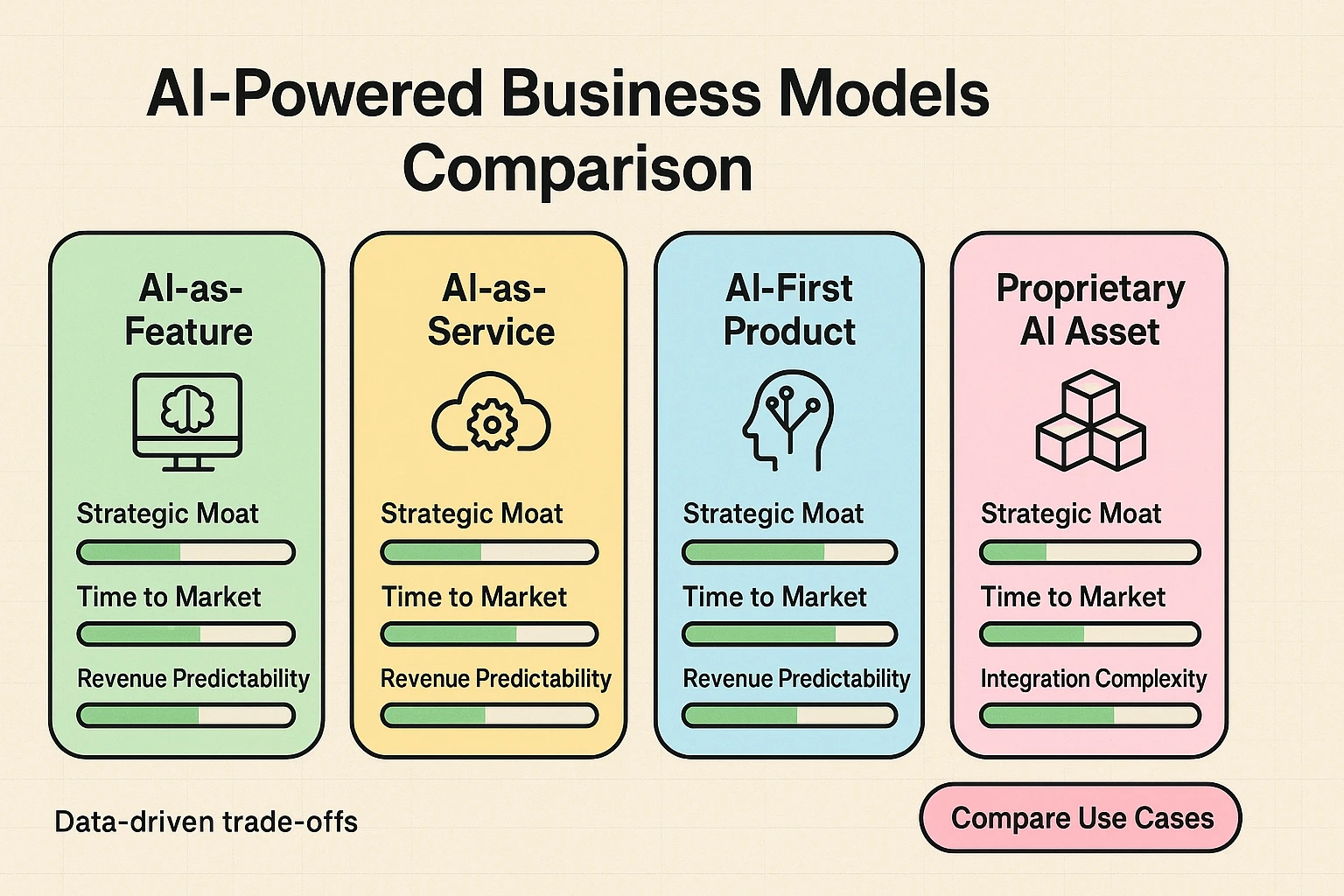
Caption: Compare four AI-powered business models at a glance — trade-offs on moat, speed to market, revenue stability and integration complexity to guide strategic choice.
- Assessment & Opportunity Identification: Begin by identifying high-impact areas within your business. This involves detailed process mining and value chain analysis to pinpoint bottlenecks, repetitive tasks ripe for automation, or unmet customer needs that AI can uniquely address. Our framework for enterprise AI vision and KPIs can help define your strategic path.
- Data Strategy for AI: AI models are only as good as the data they're trained on. A robust data strategy, including clean, well-governed data and potentially a modern data lakehouse platform, is foundational. This ensures your AI initiatives have the fuel they need to perform effectively. For guidance on structuring your data, consider our insights on AI data management automation.
- Choosing the Right AI Solutions (Build vs. Buy): Deciding whether to leverage AIaaS solutions or build custom models is crucial. AIaaS offers speed and lower entry barriers, ideal for common applications like CRM integrations or basic chatbots. Custom models, while requiring more investment, offer proprietary intelligence, deeper integration, and a stronger competitive moat for core business functions. Your choice depends on the desired level of differentiation and control.
- Pilot Programs & Scalability: While exciting, AI implementation comes with challenges. Perplexity reports that 95% of generative AI pilot programs fail due to poor enterprise integration and organizational learning gaps, not AI quality issues. Key challenges include high costs, uncertain ROI, data quality problems, skills gaps, and integration complexities. Successful implementation requires careful piloting, iterative development, and a clear roadmap for scaling.
Prioritizing AI Initiatives: A Decision Toolkit
To prevent costly, low-impact pilots, a clear prioritization framework is essential.
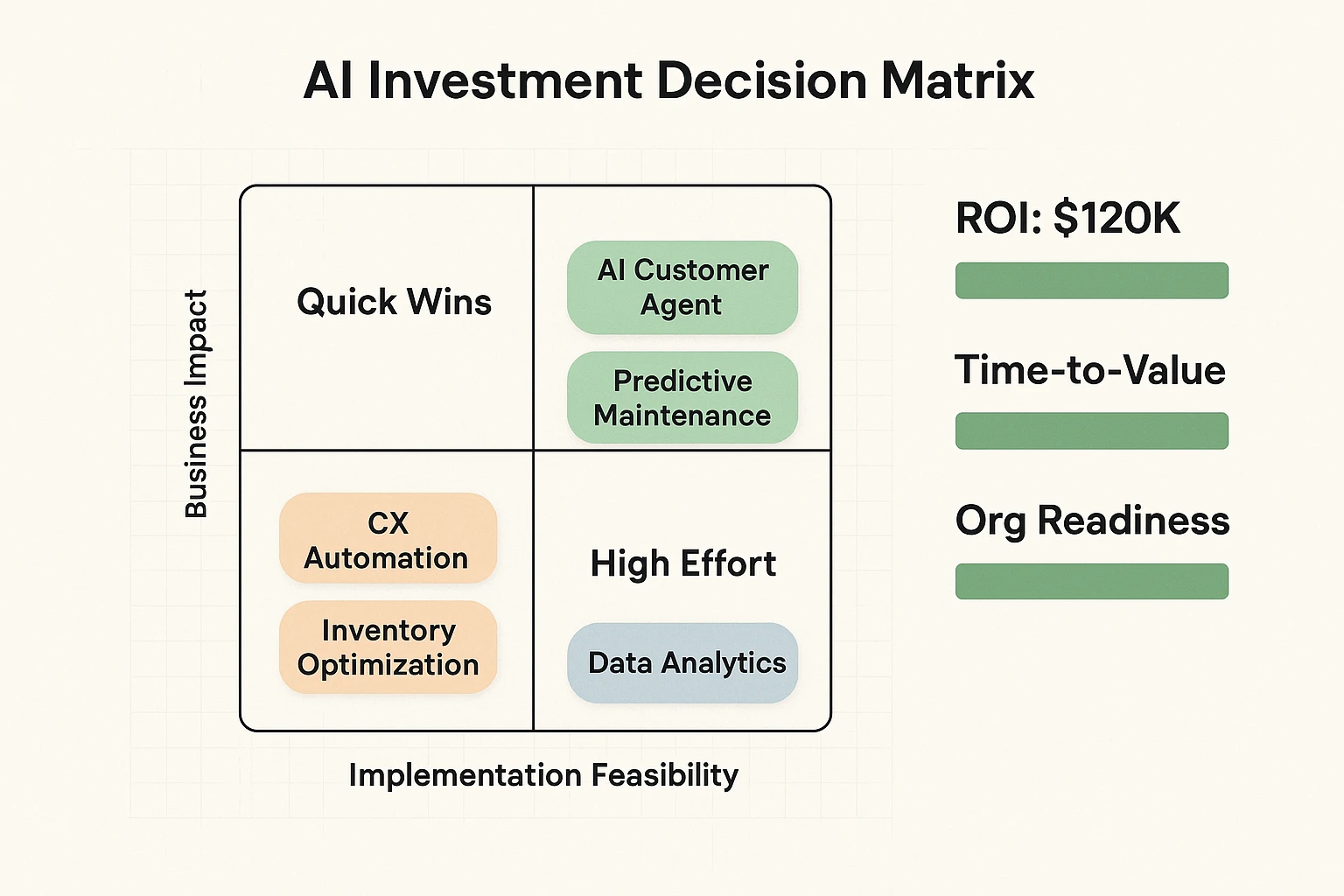
Caption: Prioritize AI initiatives with an impact-feasibility matrix plus ROI, time-to-value, and readiness indicators — designed to prevent costly, low-impact pilots.
This framework allows you to evaluate initiatives based on their potential impact, feasibility, estimated ROI, time-to-value, and your organizational readiness.
ROI and Stakeholder Persuasion
To justify AI investments, you need a concise ROI snapshot that resonates with stakeholders.
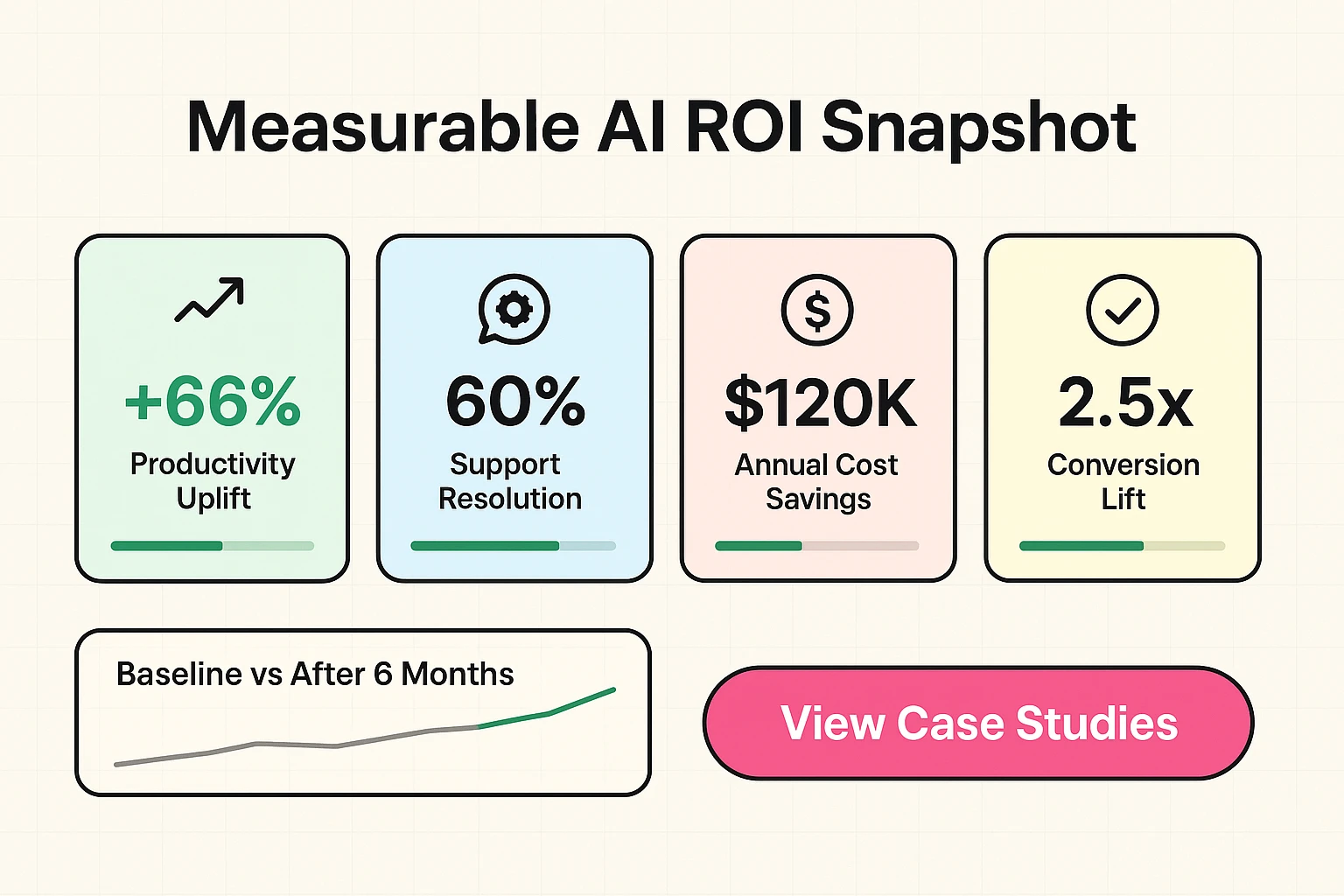
Caption: A concise ROI snapshot presenting productivity, support automation, cost savings, and conversion gains to help stakeholders justify AI investment.
This visual distills the complex benefits of AI into clear, quantifiable metrics, demonstrating how AI can drive enhanced productivity, automate support, reduce costs, and boost conversion rates.
Building Trust & Ensuring Responsible AI
As you deploy AI, trust is paramount. Ethical AI by design integrates principles of fairness, transparency, and accountability from the outset, not as an afterthought. Robust data privacy and security frameworks are non-negotiable, safeguarding customer trust and ensuring compliance.
Implementation Roadmap with Ethics Checkpoint
A pragmatic roadmap ensures successful deployment while prioritizing ethical considerations.
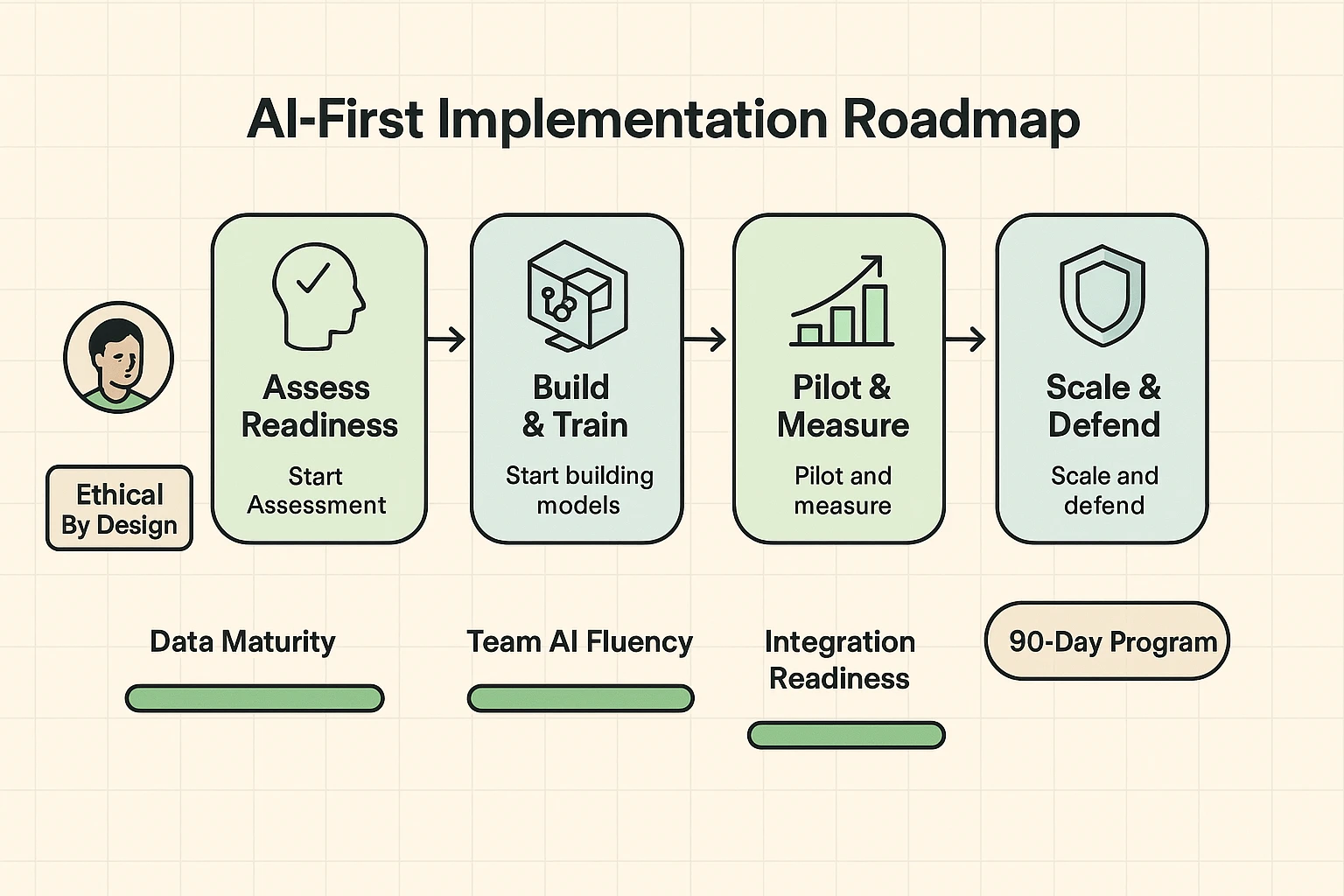
Caption: A pragmatic implementation roadmap with readiness gauges and an ethics checkpoint to build trust and reduce pilot failure risk when adopting AI.
This roadmap integrates readiness gauges and an ethics checkpoint into your implementation strategy, significantly reducing the risk of project failure and building confidence among users and stakeholders.
Case Studies: Pioneers in AI-Powered Value Creation
Real-world examples illustrate the transformative power of AI:
- Shopify's AI-First Hiring: By strategically integrating AI into their talent acquisition, Shopify ensures that AI handles initial screening and analysis, allowing human recruiters to focus on high-value candidate engagement and strategic workforce planning. This exemplifies using AI to augment human capabilities rather than replace them.
- Zendesk's Generative AI for CX: Zendesk's EAP for generative AI allows businesses to rapidly deploy AI for tasks like summarizing support tickets, generating responses, and expanding help center content. This not only boosts agent productivity but significantly enhances the customer experience with faster, more consistent support—a core AI-enabled service.
- [Your future success story]: Imagine a regional financial firm using proprietary AI models to predict local economic shifts, offering hyper-personalized investment advice unmatched by larger, more generic competitors. This isn't just efficiency; it's a new, deeply differentiated value proposition.
The Future is AI-Powered, Human-Augmented
The journey to an AI-powered business model is complex but essential for future relevance and growth. It's about strategically embedding AI, empowering your team, and continuously innovating your value proposition. The goal isn't AI for AI's sake, but AI as the engine for a more intelligent, adaptable, and ultimately human-centric business.
Ready to explore how BenAI can help you reshape your business model and unleash new value with AI?
***
Frequently Asked Questions: Developing AI-Powered Business Models
Q1: What does it mean to have an "AI-powered business model" versus just using AI tools?
An AI-powered business model fundamentally rethinks how you create, deliver, and capture value using AI as a core component. It’s not just about automating existing tasks (e.g., using an AI writing assistant for emails) but about AI enabling entirely new product capabilities, services, customer interactions, or operational efficiencies that were previously impossible. For example, a traditional streaming service offers content; an AI-powered one offers hyper-personalized content recommendations and adaptive user interfaces that predict viewing habits, creating a new layer of value.
Q2: Will integrating AI into our business model mean we have to downsize our team?
Not necessarily. While some tasks may be automated, the dominant trend is job transformation and augmentation, not mass elimination. McKinsey reports that 60% of US jobs will be significantly altered by AI, but many will be enhanced. For instance, AI can handle repetitive data entry, freeing employees for more strategic analysis, creative problem-solving, or complex customer relationships. The focus shifts to upskilling your workforce to collaborate effectively with AI, leading to increased productivity (Nielsen Norman Group shows a 66% uplift with generative AI) and the creation of higher-value roles.
Q3: Is our data secure and private when building AI into our core operations?
Yes, but it requires deliberate strategy and robust frameworks. Data privacy and security are paramount. At BenAI, we emphasize "Ethical AI by Design," meaning privacy-preserving techniques, secure data governance, and compliance with regulations are integrated from the initial stages of AI model development. Choosing reliable partners and ensuring transparency in how data is collected, used, and stored is critical to maintaining trust.
Q4: We're a small to medium-sized business. Is an AI-powered business model only for large enterprises?
Absolutely not. While large enterprises have more resources, SMBs can be more agile in adopting AI. The key is strategic implementation. Start by identifying high-impact areas where AI can solve a critical pain point or create a unique selling proposition. Leveraging AIaaS platforms can provide quick wins, and focusing on niche markets with AI-enhanced offerings can be a powerful differentiator. Small businesses can gain significant competitive advantage by being early, smart adopters.
Q5: How can BenAI help us develop our AI-powered business model?
BenAI acts as your expert partner in this transformation journey. We offer:
- Strategic Consulting: We help you identify high-impact AI opportunities and define a clear AI vision tailored to your business goals.
- Custom AI Implementations: We build and integrate bespoke AI solutions that create proprietary value and competitive advantage.
- AI Training & Upskilling: We empower your team with the knowledge and skills needed to leverage AI effectively, fostering a true human-AI synergy.
- Proven AI Systems: We provide access to proven frameworks and methodologies for building AI-first operations in areas like marketing and recruiting.
Our goal is to help you move beyond experimentation to full-scale AI integration, ensuring sustainable growth and market leadership.
Join Our Growing AI Business Community
Get access to our AI Automations templates, 1:1 Tech support, 1:1 Solution Engineers, Step-by-step breakdowns and a community of forward-thinking business owners.

Latest Blogs
Explore our latest blog posts and insights.